The Show 9.3.16
Showing posts with label L2 Composing. Show all posts
Showing posts with label L2 Composing. Show all posts
Monday, 14 March 2016

Tuesday, 1 December 2015
Tuesday, 24 November 2015
Tuesday, 17 November 2015
Sound for Film
Academy Award® winning writer-director George Lucas (Star Wars, American Graffiti) once told a reporter at Variety, “Sound is 50 percent of the moviegoing experience.” But in a recent video interview, Trance director Danny Boyle says that sound makes an even greater impact.
“The truth is, for me, it’s obvious that 70, 80 percent of a movie is sound,” he says. “You don’t realise it because you can’t see it.”
When making a film, sound is very important.
This sound can be record whilst filming or recorded separately and added to the film later.
Whether the character in the film can hear the sound or not is unrelated to the process of recording it.
Diegetic sound is that which the character can hear.
Non Diegetic sound is that which the character cannot hear.
The sound of film can be broken down into different elements that create the atmosphere and describe to the audience what is happening.
Voice over (This is used when eh dialogue captured during the recording is not good enough quality.) (Diegetic)
Foley (This is the sounds added after the film was made and often exaggerates the action and tells you what is happening during the film.e.g. door opening, gun shot, punching.) (Diegetic)
Sound Track (This is the musical score and any atmospheric sounds used to enhance the mood of the film, often orchestral, or popular music songs or sounds to add tension. (Non- Diegetic)
Your task is to find examples of these and embed them on your blog!
Tuesday, 13 October 2015
Lyric Writing
Brief 1
Lyric writing can as is seen as the hardest part of songwriting.
Thee job can be made easier by breaking it down into several parts.
First come up with an intention.
1. What kind of song is it?
2. Person narrative ...First (I) , Second(You), Third (They)
3. Where is the narrative based?
4. What happens in this narrative.
Rhyme.
This is usually where people start, they think of a line and try to end the last word of corresponding lines.
Starting with the lyric is a great way of writing you will need to find the meter and rhythm of the lyric and build the song up from there
Try using a rhythm first, and use this to fit the internal rhythm of the lyric on and around, you will probably need to change the phrasing of the words, or the words themselves.
Some lyrical devices
http://www.world-of-songwriting.com/poetic-devices.html
Lyric writing can as is seen as the hardest part of songwriting.
Thee job can be made easier by breaking it down into several parts.
First come up with an intention.
1. What kind of song is it?
2. Person narrative ...First (I) , Second(You), Third (They)
3. Where is the narrative based?
4. What happens in this narrative.
Rhyme.
This is usually where people start, they think of a line and try to end the last word of corresponding lines.
Starting with the lyric is a great way of writing you will need to find the meter and rhythm of the lyric and build the song up from there
Try using a rhythm first, and use this to fit the internal rhythm of the lyric on and around, you will probably need to change the phrasing of the words, or the words themselves.
Some lyrical devices
http://www.world-of-songwriting.com/poetic-devices.html
Wednesday, 23 September 2015
Another section! 29.9.15
Last week (22nd) we started our songs using a tree chord trick!
This week I would like you to write a new and different chard sequence to your last one and add it, making a new section.
Try and make the first chord of your new section a different one from the chords you were using in your previous sequence.
1. First look at the chords you used (1 4 5)
2. The find a chord that sounds like a you have changed sections.
3. Add them to your original chord sequence.
you can use the same chords but they should be in a differer order.
This week I would like you to write a new and different chard sequence to your last one and add it, making a new section.
Try and make the first chord of your new section a different one from the chords you were using in your previous sequence.
1. First look at the chords you used (1 4 5)
2. The find a chord that sounds like a you have changed sections.
3. Add them to your original chord sequence.
you can use the same chords but they should be in a differer order.
Saturday, 19 September 2015
3 Chord Trick
1 2 3 4 5 6 7
C D- E- F G A- B dim
The anchor points and 3 most important chords of a key are 1 4 5!
These in the key of C are C F G notice the are all major!
Your task today is to construct two different patterns using only these chords and then put a melody to it!
Other 3 chord tricks can use the relative minor.
The relative minor of C is A- the relitive minor of F is D- and the relitive minor of G is E minor.
The realive major and minors are pretty much interchangable but add a different texture.
Saturday, 12 September 2015
Piano and Chords

A Musical Note: is a single pitched sound.
Scale: A set of musical notes put into an order
Key: The pitch at which the a scale is.
Interval: The distance between two notes
Semitone: The smallest distance between two musical notes (americans call it half step)
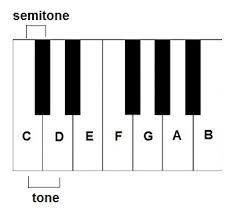
Tone: Two Semitones (the second smallest distance between two notes. Americans call it whole step)

Minor third: Three Semitones ( The important interval in a minor chord)

Major third: Four Semitones (The important distance in a major chord)

Perfect Fifth: Seven Semitones

Major scale: Tone, Tone, Semitone, Tone Tone Tone Semitone

Root note: Name of a chord or the musical note where you start when building a chord
Chord: Three or more notes played at the same time.
Major Chord: Root + Major third + fifth

Minor Chord: Root + Minor third + fifth
Homework: To be able to play every chord and name it in the key of C Major
Subscribe to:
Posts (Atom)